


The Echo of the Trail: Reflections and Encounters on My Camino Journey

On June 9, 2026, I set out on the Camino de Santiago to walk 800 kilometers, over the Pyrenees in France and into northern Spain. I returned with something I had not expected: a journey that was still unfolding. For 36 days I walked through Spain, often alone, meeting people from around the world, listening to their stories, confronting my own questions, experiencing moments of extraordinary human connection—and, unexpectedly, encountering hatred as well.
The Camino taught me that the road does not necessarily give us the answers we seek. Sometimes, it gives us something more valuable: the courage to ask better questions. These are some of the stories, encounters and reflections that stayed with me after I stopped walking.
Chapter 1: Coming Home and the Rhythm of the Trail
When you return home from the Camino, it takes the mind a long time to step off the trail. I was on the Camino for 39 days, 35 and a half of which were walking days. I crossed four different geographical regions. It hardly rained-which was definitely for the best-but there were also some very hot days.
I am very pleased with how things went physically. I had a few challenges along the way, but nothing I couldn't handle.
In total, I walked between 280 and 300 hours. That is a lot of walking hours. About 90% of them I walked alone - meaning around 250 hours of solitary walking. That is a very long time. It was difficult at times.
And there were many moments of being alone. That isn't necessarily a bad thing, but there were also moments of loneliness. And some of them weren’t even related to the walking itself.
There were breathtaking, magnificent sights, as well as quite a few rather boring stretches.
I went 30 days without a single blister, which was very important to me. Until day 30, when the first blister appeared, and it was not simple at all. Toward the end, another small blister was added, but by that point, I really didn’t care anymore.
I carried my backpack on all days except for six, which was important to me.
I slept 20 nights in dorm rooms, with anywhere from one to 60 people in a room, and another 18 nights in private rooms. It was challenging - I’ll explain why later.
I met wonderful people from around 30 or 40 different countries, and I carry their stories and our encounters in my heart.
I am also very glad that at least 15 of the stories I heard are directly relevant to the book I am writing on meaning and hope in times of crisis. This was one of the things I was worried about - that these stories and I wouldn't cross paths. I worried about it at first, but in the end, I met extraordinary people.
I attended five Catholic masses. When you think about it, four out of the five Catholic masses I’ve attended in my entire life were during the Camino. That is quite amazing to me.
There were moments when I was moved to tears. Unfortunately, I went through a very difficult, frightening, and humiliating experience, from which I emerged physically unharmed, but one that gave me a lot of food for thought that I will carry home with me. The backdrop was anti-Israeliness and antisemitism. I will explain this later as well.
I also carry with me the sense of solidarity and immense love that flows so naturally along the Camino.
But like all good things, this too comes to an end.
About all of these - I will write.
I want to end with one story. I met a man named Laurent. He allowed me to use his name. He is French, 63 years old, and an extraordinary human being. I had dinner with him. For 15 years now, he has been coping with a degenerative neurological disease. He had done short sections of the Camino in the past, but this time he decided to walk the entire way, starting in France even before I set out.
By the end of his journey, he will have walked for almost three months. I said to him: "Laurent, you are amazing. What makes you do this? Why is this so important to you?" He walks almost as if relying on crutches, yet he possesses an extraordinary determination. He told me: "For me, it is very important to connect with my body as it is today. One day at a time. I know that in a few years I won't be able to do this anymore. So I want to prove to myself that a large part of the pain is in my head, not in my body. And I know this is true, because I've been living this way for years."

He is also deeply connected to the spiritual aspects of the Camino. I was simply in awe of him. I think Laurent's story is the right place to pause for now. The Camino showed me that it is possible. That you can challenge yourself. That you can push yourself just a little bit further. And that there are always things you still don't know about yourself. And the main thing is simply to get up in the morning and keep walking until the next day.
Listen to this wonderful song that we listened to a lot on the Camino:
Chapter 2: The Camino is a Particular Kind of Walking
We take walking for granted. Most of us have the privilege and right to walk, even though not everyone can, and not everyone has ever had that right. For thousands of years, before there were machines, trains, cars, and airplanes, walking was simply how human beings moved from place to place. I remember that on a trek in western Rwanda, I met people who had been on the road for several days – walking - to reach a family wedding. Humans and walking have gone hand in hand since time immemorial.
But walking on the Camino is something completely different. The walking - which is by definition "somewhat strenuous" - is not meant for sport, but as a "pilgrimage." Historically, in this case, it was a Catholic pilgrimage - and it still is - but in recent decades, people from all over the world have joined, coming not for religious purposes, but for personal growth in one way or another.
Of course, we walk to get somewhere - to the next village, the next section, and ultimately to Santiago. But I believe the walking here is far more than a means to get from point A to point B. It is a state of being, a mindset.
People don't come here just for a hike or a trek. They come to walk the Camino.
Sometimes the walking itself is quite routine. During the days, I spent long stretches of time along the road (with very little traffic). It was hot (very hot!), and the scenery was not always dramatic - I would even say boring. But I realized that the true journey is not just the one happening under my feet; it is the journey taking place inside me.
When you walk hour after hour, feeling the weight of your pack, the heat of the sun, and the rhythm of your steps, your thoughts begin to wander. You might have arrived with a specific question, hoping to find an answer, but instead, your mind strays to entirely different places. That is simply the nature of consciousness.

Many of the pilgrims I met arrived here at turning points in their lives. Some had just retired and were asking themselves, "What now?". Others had left a job, experienced a breakup, or were grieving a loved one. I heard heartbreaking stories, but also deeply inspiring ones.
What seems to be shared by everyone is the feeling that this extended period of walking is an experience they would never get to have in their daily routine.
Perhaps this is one of the spiritual dimensions of the Camino. Walking creates space. It gradually clears the mind, quiets the soul, and allows something new to emerge. Yes, even while sweat drips down your body and your feet ache..
.
That is why I believe the great gift of the Camino lies precisely in its length. It takes time for our minds to adjust. It takes time to leave daily worries behind and enter the different rhythm of the journey.
I wonder if cyclists experience something similar. I assume many of them do, but I also believe there is a uniqueness to the pace of walking. At four or five kilometers per hour, life slows down enough for us to notice things we might otherwise miss - both around us and within us.
Walking also brings people together in unexpected ways. I spent long hours alone, but I also found myself in conversations with people from thirty or forty different countries. You never know where a simple greeting of "Buen Camino" ("May you have a good Camino") might lead.
I spent several hours talking with a man from France. He told me that only after his great-uncle - his grandfather's brother - passed away did the family discover that during the Holocaust, he had hidden and saved a Jewish child. The uncle had never spoken about it. My new friend later worked to have his family recognized by Yad Vashem as Righteous Among the Nations.
This story moved me deeply, not only because I am the son of a Holocaust survivor, but because of the years I spent interviewing children of Holocaust survivors for my second-generation research, including some whose lives were saved in France.
I also met people who came to the Camino looking for answers, only to find that the answers they expected never arrived. In their place, something else entirely surfaced.
When you walk hundreds of kilometers, often in silence, you lose control over where your thoughts will drift. In that sense, walking becomes a form of meditation.
Of course, there are people who approach the Camino almost like a marathon, entirely focused on reaching Santiago. I understand that. Having walked hundreds of kilometers myself, I certainly want to arrive too.
But I am beginning to think that the true value of the Camino is not just reaching the destination. The value is what happens to us along the way.
There is no thermometer that can measure this. No watch or app can log it. Perhaps we only begin to understand it after returning home, discovering that in some quiet way, the Camino continues to walk within us.
Chapter 3: The Camino is People

Not everyone understands this because all the attention goes to the 800 km, or however much it ends up being. And rightly so. It is a sustained physical effort that, by the way, the body gets used to - I know it's hard to believe. But what's the deal with the people, you might ask?
In my opinion, this is one of the "secrets" of the Camino, even the short ones, but undoubtedly in the long journeys of 4-6 weeks or more. Whoever comes alone will not stay alone; whoever comes "together" will find even more "together." I have seen such phenomena throughout my life on trips in nature - and not just in nature - in various places around the world, but on the Camino, in my humble opinion, the playing field is different.
Here, everyone feels the path - everyone is moving in the same direction, usually following certain "stages," more or less. The magic of the Camino is that everyone brings their own world to the trail ("Camino" is the Spanish word for way or path), and the path "does something to them." Obviously, not everyone is in the same headspace, but most are. Here you almost never hear arguments (almost... I have a very different story later on), you feel a lot of openness, flow, curiosity - and yes, generosity of heart. I am talking about the pilgrims (meaning the travelers), not the local population, with whom relationships are mostly businesslike (we are the customers bringing in money).
The human magic on the Camino is that you feel yourself continuing to connect with more and more people in a natural way. "Where are you from?" is the first question; "Buen Camino" ("Good Camino") is the blessing you hear countless times every hour. I think that on the Camino I had dozens of conversations of all kinds, and perhaps hundreds of exchanges of greetings with fellow walkers along the way.
Where does this magic come from? Did everyone suddenly take some "happiness and love pill" making the vibes so positive? Of course not... but there is something that emerges from walking so much and making such an effort, a connection to the path beyond physical exertion, something "spiritual"—and everyone can take that word wherever it fits for them, because we are not identical.
Where else in the world do you have people in their 60s, 70s, and older alongside young folks in their 20s and 30s? Day after day! Those same people later disperse into albergues (hostels), most sleeping in rooms with one other person or with 10, 20, or maybe more. It works smoothly; there is a sense of "togetherness" even when you are not explicitly together.
I found myself shifting from being alone a lot during my walk to suddenly having dinner with a group of young Italians, or a father and daughter from Ireland, or a few couples from Australia. A lone woman from Korea walking by herself, a guy walking for two months already from the Netherlands, a young priest from the US, and a 27-year-old girl from France who had seen a lot in her young life - suddenly we all sit together around cheap, wonderful local wine.
Call it fleeting love, call it a travel experience - I simply see it as one of the greatest assets of the journey. Of course, very few of these people will stay in touch long-term - isn't that how life is in general? People enter and exit your life... but there are those who leave a mark on your heart.

I certainly carry their stories in my heart: grief for a deceased husband, tension over a job that is no more, existential questions rising and falling, and the desire to share with another person what truly matters to you, what hurts, and what is precious to your heart.
The Camino is the people on the way. Even when you are no longer there. The Camino can echo for a long time. That is exactly how I feel.
Chapter 4: We Don't Need Most of Our Stuff
One of the things the Camino journey demonstrates as a real-world "life laboratory" is that you truly need very little. True, life is not walking the Camino, but walking the Camino can teach us many things about life.
For example, if I told you that for 33 out of the 36 days I walked, I wore the exact same shirt day after day! Smelly? No, because one of my tasks every day upon arrival (usually at 3:00 or 4:00 PM), after managing to shower and find where to wash clothes, was to take whatever soap was available with running water, scrub a bit, get the sweat out, and hang it on the line, if there was one. Was it squeaky clean? Of course not, but it was good enough for tomorrow's walk. And when I went to bed for a short rest before going out to look for dinner, I felt I had accomplished something.

On the Camino, no one really cares if or what brand-name clothes you have; you are in a framework that is, by definition - in my opinion at least - minimalism. How beautiful, how liberating that is...
That is also why it was important for me to carry my own pack - the 8-9 kg on my back served as a reminder that I carry what I need, and if it's unnecessary, I'll feel it. It's no wonder people on the trail run to the post office to ship excess items back home. On six out of the 36 days, I sent my bag ahead to the next location - for 5 - 7 euros each time-and carried a small daypack with me.
There's no doubt it made things easier, and it's very tempting to get used to it - there's nothing wrong with that - but I wanted to "send a message to myself," and I wasn't the only one. Taking responsibility for my decisions on what to bring and what not to bring. When I had large blisters, I gave myself a pass, but generally, I didn't.
In this sense, the Camino is a wonderful metaphor for life: what do you carry, and what do you let go of? In my life, I have never worn the same shirt so many times, and I am also happy to get home and change every day. But this experience stays with me - for future lessons in life as well...
Chapter 5: The Spirituality of the Camino: Definitely Not Just for Catholics
After about 15 days on the Camino, I started feeling that I was missing something. I was focused almost entirely on myself: how I was walking, how I was feeling, where I would book a place to sleep, what I would eat at the next break. I felt that this constant focus on my own needs was pulling me away from where I actually was. I was looking for something beyond the "walking marathon" and the drive to "get there."
One day I decided to open myself up to what was happening around the many churches along the way. I wanted to understand what drew so many pilgrims to them. Not out of a desire to become Christian, but out of a desire to witness the emotion, faith, and experience of others.

It was one of the most significant decisions I made on the Camino.
I must say something about the home I grew up in.
I grew up in the United States, mainly in New York, and for the first fourteen years of my life, you could count the number of Christians I met on the fingers of one hand. I lived in a Jewish neighborhood, attended a Jewish school, went to synagogue every Shabbat, and in the summer, I was at a Jewish summer camp or in Israel. Only at age fourteen did the world begin to open up, and within about a decade, I was living almost exclusively among non-Jews in the Far East.
But that is only part of the story.
My father was a Holocaust survivor who lost his entire family, except for one surviving sister. He lost his home, his culture, his community, and everything he had - simply because he was Jewish.
For him, encountering the non-Jewish world was always tied to the memory of deadly antisemitism. When my parents raised us, the cross was not a symbol of love or compassion. It symbolized distance, threat, "not one of ours."
It took me years to make peace with that symbol, until I no longer felt uncomfortable in front of it.
So, when I decided to enter more of the churches along the way, something inside me still resisted. Not a conscious resistance, but a deep memory of centuries in which Jews were discriminated against, excluded, and sometimes destroyed in the name of that very cross.
And yet, the world does not stand still. People change. And perhaps we can change too.
I started participating in gatherings and sharing circles held in churches. The same question was always asked: "What brought you to the Camino?" Only after that came the question that was sometimes more complex for me: "Where are you from?"
Suddenly I found myself sitting in a circle with pilgrims from all over the world. Each person shared who they were, where they came from, and what led them to set out on this journey. Some spoke of loss, others of searching, of hope, of a new beginning.
When my turn came, I found myself no less moved than they were.
One evening, a group of nuns entered with a guitar. They handed out song sheets - folk songs, songs of peace, and songs from the sixties and seventies from around the world. There was a sense of spiritual elevation. The exhaustion of a long day’s walk blended with the music, and I was simply happy to be there.
On one of the evenings, I stayed for mass. It was entirely in Spanish. I only understood a small part of what was said, but I was captivated by the quiet, the music, the people kneeling or crossing themselves. To my surprise, it didn't feel threatening at all.
On the contrary.
It touched me.
Singing with the nuns in Carrión de los Condes (Youtube, public domain)
Even though I do not belong to that world, I could connect to the emotions of the people around me. I saw the serious, sometimes tearful faces of people on a deeply meaningful pilgrimage.
I felt the place was sacred not because of the stones, but because of what people carried in their hearts.
During the Camino, I attended four masses. Before that, in my entire life, I had only been to one.
At the end of each mass, pilgrims were invited to approach the priests and nuns to receive the "pilgrim's blessing."
At first, I hesitated.
"Don't overdo it," the small voice in my head said.
But I approached.
Again, everyone was asked to say where they came from.
And again, I faced that same dilemma.
When my turn came, I hesitated for a second and said: "Israel."
The nun smiled at me warmly.
I breathed a sigh of relief.
"It went smoothly," I told myself.
Then she said: "We want to bless you all on your way to Santiago. You may have questions, difficulties, or challenges. It is important to us that you know we are praying for you, and for the important journey you are making."
And again, I felt moved.
What a beautiful thought, that someone who doesn't know me at all is praying for me.
Not so that I become like her.
But simply because I am a human being walking the path.
In that moment, I touched the spirituality of the Camino.
Not because I changed my belief.
But because I learned that it is possible to respect another's faith, to be moved by it, and even to feel blessed by it - without losing anything of my own identity.
To me, that too is part of the beauty of the Camino.
Chapter 6: On the 30th Day of the Journey, I Met Hatred in the Eyes


This chapter is without a doubt the most difficult one for me to write. Not because I don't know what happened or what I want to say, but because I don't like what I am about to write, and I still don't fully know how to process it. This experience has ripples in depths that are still hard for me to pinpoint.
I do not want this event to take on too central, or inaccurate, a place in the overall story of "my Camino." They say that every pilgrim on the Camino has their own Camino, fundamentally different from anyone else's. I resonate with that deeply. Your Camino consists of everything you did, felt, understood, and discovered along the way, but also of what was done to you and what you understood as a result.
Therefore, I do not want the event I describe here to be brushed aside with statements like "it was just an isolated incident" or "in the end, nothing happened." My Camino was so much more than this vile and hurtful event. But my Camino will also never be complete without it.
Background
Months before setting out on the Camino, I wondered and asked about the attitude toward Israelis along the trail. Regrettably, since October 7th, this has become an almost natural question. I knew that politically, Spain strongly opposes Israel's policies, especially since the start of the current war. Nothing I looked into deterred me particularly.
I hold dual citizenship. I was born and raised in the United States, lived there for 23 years, and English is my mother tongue. Technically, I could present myself as American, and I even planned to do so at times for safety reasons.
But I knew it would be hard for me to do that for long.
I have lived in Israel for nearly forty years. The Camino is also a place where people engage in more than just "small talk." They share life stories, pain, loss, hope, and deeply personal matters. Authenticity is part of the dynamic of the trail.
And the question "Where are you from?" comes up again and again, sometimes several times an hour. People might forget your name a moment after hearing it, but they will remember well which country you came from.
I knew that the chance I could hide the fact that I am Israeli over time was nearly zero.
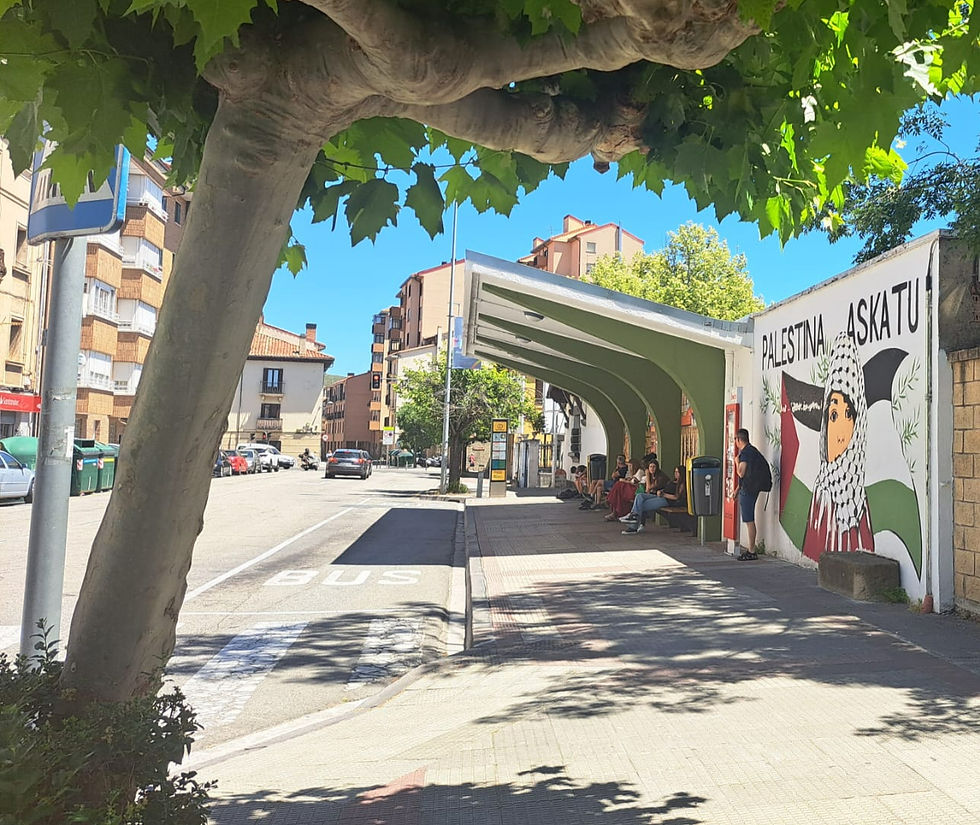
Not that I didn't try here and there, especially during the first 150 -200 kilometers of the French Camino. Along the way, I repeatedly encountered anti-Israel graffiti, calls for boycotts, slogans like "Israel = Genocide," Palestinian flags on balconies, and even swastikas.
I didn't let every such thing overtake me, but I couldn't ignore it either. Something seeped in: perhaps this isn't the best place to talk freely about my
life in Israel. Am I truly welcome here?
The Incident

It was at the end of a long, hot, and particularly grueling day of walking: about 31 kilometers, including a steep descent over loose stones. I arrived in Villafranca del Bierzo, about 600 kilometers from where I started walking on the French side of the Pyrenees.
After showering and settling into my albergue on one side of town, I pushed myself to get up and walk to the other side, to a well-known albergue where communal meals were held for pilgrims. I wanted to be with the young people I had met along the way, mostly warm and pleasant Italians, to eat together and hear other people's stories. That was one of the things I was looking for on the Camino.
It never crossed my mind that I was about to become "the story of the evening."
We sat around the table waiting for the paella. The owner, a well-known and beloved figure in the Camino world, asked us to stand up, join hands, and chant joyfully together in honor of our shared path. After that sweet and moving little ritual, I felt even more at home.
Most of the people around the table were pilgrims I knew. We already had hours of walking, eating, and singing together behind us. There was also an older Spanish father with his daughter, around twelve years old, who were traveling on electric bikes. Next to me sat a man who looked like a local and was not a pilgrim.
The German guy sitting to my right was excited to hear I was from Israel and asked aloud: "Where in Israel are you from?"
The man sitting to my left, with whom I had previously exchanged a few polite words, and who mentioned he was a masseur offering massages to pilgrims in the area, turned to me immediately and asked nervously: “Are you a Jew?”
I answered quietly and pleasantly: "Yes. I am Jewish and I live in Israel."
And then it all started.
He screamed at me, asking what I thought about the murder of women and children, if I opposed "genocide," and if I recognized that genocide was taking place. I answered calmly that I didn't know if that was the right definition, but that there was no doubt it was a terrible tragedy.
He was not interested in the answer at all.
For long minutes, he shouted at me that my friends and I were murderers, that Israel was committing genocide, that Jews were worse than Nazis, that he used to love Jews because of what the Nazis did but now hated Jews, that I was not welcome in his country, that Israel had no right to exist, and that we would never have peace.
Over and over, he yelled in my ear: “Free Palestine! Free Palestine!”
The Spanish man traveling with his daughter joined in, saying that Israelis were doing to Palestinians what the Nazis did to the Jews.
I sat there looking at the man next to me, brimming with hatred, and I didn't say a word.
Later, people told me they were impressed by how calm I remained. The truth is that in those moments, I didn't feel fear.
The fear came later.
In that moment, I was only waiting, in the secret depths of my heart, for someone to stop him.
The American priest sitting across from me tried to intervene. The man aggressively shut him down too. An Italian guy I knew tried to tell him in Spanish that we were on the Camino and that this was no place for such behavior. He reacted fiercely to him as well
.
The priest asked if I wanted to switch seats with him at the table. I said there was no need.
Silence fell over the table, while the man beside me continued to shout in my ear: “Free Palestine! I can’t believe you are sitting next to me.” He made facial and body movements showing his shock and disgust at having me near him.
When I felt I had endured enough, I stood up from my chair.
And then he did the most humiliating and despicable thing I have ever experienced in my life: he spat at my feet.
I walked out to the albergue courtyard in shock and sat on a bench. A few young European women sitting there nodded to me and said: “I’m sorry for you.”
The German guy came out to me and tried to calm me down. By then, what hadn't been visible a few minutes earlier was likely clear on my face
.
I kept asking over and over: "Why didn't the owners intervene?"
Only then did I begin to grasp the magnitude of the event. I realized that it was something that came very close to physical violence, in the middle of a wonderful journey that up to that point had been filled with love, acceptance, and friendship.
Even when the man came out to the courtyard, he continued to yell at me: “Free Palestine! Free Palestine!”
A few minutes later, I went back inside to return my glass and look at the people remaining at the table. Most of the pilgrims had already dispersed. A few of the Spanish locals remained, chatting among themselves.
No one approached me.
No one asked how I was.
The German guy kindly walked me back to my albergue on the other side of town. My thoughts were already turning to the next morning: Who was this man? Was he connected to the albergue? Would I meet him again on the trail? Were there other people like him around?
When I got back, I avoided going straight into the dorm room. I didn't want to encounter the Spanish man lying in the bed next to mine, after he had already made unpleasant faces at me when he heard I was from Israel.
I called home to friends who had recently returned from a long trip in the Far East and who had also walked the Camino in the past. I poured my heart out. They supported and strengthened me. I made it through the night safely.
The Next Day
I was afraid to set out early, before first light. Everyone on the Camino walks in roughly the same direction, toward Galicia and Santiago. I didn't know if I would encounter the man again, who he was connected to, or if he moved between towns alongside the pilgrims.
Further down the trail, I met the two American priests who had sat with me at the meal. The senior priest invited me to talk about what had happened the previous evening.
I began to share and thanked him for trying to intervene.
And then he said: “I refuse to be a bystander.”
In that moment, tears burst forth.
I told him: "You have no idea what those words mean to me."
Not because what happened to me that evening was similar to the Holocaust. Of course not. But because I am the son of a Holocaust survivor, a son of a family that lost so many. To me, the story of the Holocaust is not just the story of the murderers and collaborators. It is also the story of millions of human beings who stood by, kept quiet, and did nothing. Standing by in the face of violence against innocent people - no matter from what nation, community, culture, or gender - is appalling to me. And this time, I was the victim.
After a short while, we moved on to another topic. I kept walking.
About twenty kilometers later, I reached the next destination. Walking gave me a brief breathing space, but when I stopped, it all came rushing back.
Why didn't the owner intervene? A person considered a spiritual and iconic figure on the Camino. It happened at his table, in his establishment, and he didn't say a word.
Why, when I later met the young pilgrims who were there again, did almost no one mention the event or ask how I was doing? Everything just returned to routine.
Later, the priest told me that after I left, he gathered the pilgrims and asked them to offer a prayer - specifically for the man who attacked me.
Where Am I Today?
I still don't fully know what I think about everything that happened.
I know the event is isolated, but also that it doesn't stand alone. It connected to everything I saw dozens of times along the way: the graffiti, the calls for boycotts, the swastikas, the Palestinian flags, and the need to think twice before answering the simple question: "Where are you from?"
Someone else might view this as a small tactical matter. For me, it is not a small thing.
All my life, I have tried to get closer to who I truly am. I have moved between countries, professions, outlooks, and ways of life. At age 23, I set out with a backpack to Asia to meet human beings and experience the world, not just through nationalities, religions, and ideologies- I lived in Asia for nearly five years as a "stranger." In my work and in my travels, I have always tried to see a person before seeing a label. For me, "being a human being"- in Yiddish, sei a mensch - is the light I strive to walk by all my life. It is also what my late father taught me.
I didn't make this entire journey in my life only to end up now thinking twice before saying who I am.
That evening, the man sitting beside me didn't see Ronnie.
He saw a Jew.
He saw an Israeli.
He saw in me a person symbolizing everything he hated.
And that hurt me deeply.
I am Jewish. I am Israeli. And I am a humanist.
I do not want to give up on any of these parts.
I do not want to become a helpless victim. I am not writing these things so people feel sorry for me. I write them because it was my experience, it was how I coped with it, and it is how it continues to live within me.
This is not my Camino - certainly not all of it.
My Camino was vastly larger, richer, and more beautiful than that evening.
But that vile event was also part of "my Camino."
I am letting it settle. I tell it to others and reflect on it within myself.
Not everything has an answer.
And meanwhile, as on the Camino, you wake up to a new day and keep walking.
Chapter 7: The Camino Has Ended. The Path Continues
So, it is time to wrap up this series of posts about my Camino.
Every story deserves an ending. Even if we don't have all the answers, we need to close the loop. Like a water bottle - in the end, you have to put the cap on and make space for the stories that will follow.
So what was the Camino for me?
It was one of the most significant experiences I have ever gone through. A long, challenging, moving, and in many ways life-changing journey. Looking back on it today, I see it through three figures: myself, my grandson Goni, and my late father.
Myself
"Only of myself did I know how to tell." (Rachel)
If I could pat myself on the back - I would. I combined three things: walking, listening to people's stories, and starting to gather material for the book I dream of writing - a book on meaning, hope, and the capacity to rise again in difficult times.
I prepared. Body, mind, and heart.
And the idea worked.
My body carried me eight hundred kilometers. I met dozens of fascinating people, had the privilege of hearing stories I will never forget, saw breathtaking scenery alongside long, dull stretches, and walked long hours alone. Maybe too much alone. There were moments of joy, of fulfillment, of emotional and even spiritual elevation. And there were also moments of loneliness.
I also learned about myself.
I learned that it is easier for me to walk thirty kilometers a day than to sleep in a room with thirty different people night after night.

But mostly, I learned how hard it is for me not to be authentic.
For as long as I can remember, I have asked people to be honest with me, and I strive to be honest with them. I want them to feel safe sharing their story. And on the Camino, I found myself more than once concealing part of my story. Not because I wanted to, but because I didn't know what was safe - and especially who was safe.
I am proud of myself for not giving up
.
I set out on the journey despite the war, despite flight cancellations, despite the uncertainty, despite another round of reserve duty for my son, and despite all the voices—from outside and inside - saying it was not the time, it didn't make sense, it wasn't safe...
I wouldn't have succeeded without the support I received from home.
But the journey wasn't exactly as I had dreamed, either.
I simply wanted to breathe freedom. To be a human being in the world. Not a representative of a country. Not a spokesperson for a political stance. Just a person meeting human beings.
Like I was when I lived in the Far East - traveling, working, learning, and above all living within other cultures, other languages, and other ways of thinking. Four and a half years that changed my life forever.
I wanted to regain that feeling for myself at age sixty-seven.
And I succeeded big time.
No.
I almost succeeded.
Sometimes almost is enough.
And sometimes almost is just almost.
The graffiti, the flags, the constant feeling of weighing whether to reveal my identity, and finally the antisemitic attack I experienced, reminded me how hard it is when I cannot simply be who I am.
While still on the Camino, I was also left with another thought.
I have sharp criticism regarding quite a few things done in and by the State of Israel. Some of this criticism has accompanied me for years, now more than ever.
But I am not confused.
I feel the importance of the State of Israel in my bones.
If the State of Israel had been established in 1938 instead of 1948, everything might have looked different.
Perhaps there would have been somewhere to flee.
Perhaps there would have been somewhere to arrive.
Perhaps I would have known grandfathers and grandmothers, uncles, aunts, and family members I never got to know.
I am not confused.
Not for a moment.
Goni
Goni, my only grandson (for now) and the love of my heart.
Let's tell the truth, sweet Goni - ours is not an equal relationship.
I thought about you every single day on the Camino. You, on the other hand... every now and then, when mom pointed the phone camera at me, you saw grandpa walking.
And that is completely fine.
That is exactly how it should be.
I dedicated this journey to you as well.
One day, when you are big enough, I hope you will know that your grandpa, at age sixty-seven, set out alone on an eight-hundred-kilometer journey - and thought of you.
Not to prove anything.
But to keep learning.
To listen.
And to grow.
I wish for you that the world remains open to you.
That you meet people different from you.
That you be curious.
That you do not fear other cultures and people who think differently than you.
That you believe in yourself.
But also that you believe in human beings.
Because despite everything I saw, I still believe there is far more good in the world than it sometimes seems.
And don't let fear be the one making decisions for you.
Dad
Dear Dad,
And somehow, no matter what I write about or how far I travel - in the end, I come back to you.
At age forty-one, our whole family stood together beside the mass grave in Zhetel (today in Belarus).
You called it a "pilgrimage" back then, long before I understood how much that phrase would accompany me.
There I heard you, for the only time in my life, cry out from the depths of your soul:
"Why did I remain alive while others went to their death?"
We filmed.
We recorded.
I turned that moment into a testimonial film for generations to come.
And from that day on, it has stayed deep within me. It is my question too.
For my fiftieth birthday, I went to a forest in southern England for a nine-day retreat, centered around four days alone in the woods without food. They called it a Vision Quest - an ancient rite of passage.
When I told you I was going, you slapped your hand to your forehead and said in utter astonishment: "Oy vey iz mir... what is this madness?"
That's how it was more than once in life.
You were frightened by my "crazy" ideas.
And I... did them anyway.
Afterward, they became a story.
And in England, too, I reached you.
This time through the forest.
I thought about the trees that hid you when you escaped to the partisans.
How amazing to think that trees can save lives.
That the very forest, a place so many fear, was a place of hope for you.
At age sixty, I traveled to India for a different journey - to volunteer, learn, experience, and mark the transition into a new decade of my life.
I planned to stay for thirty-five days.
On the tenth day, I got a phone call.
They told me you were likely on your deathbed.
I returned.
I stood by your bed with Merav and the kids.
I saw you breathing heavily, inside a body growing weaker.
I kissed you on the forehead.
And I promised you.
I promised that your story would not be forgotten.
That I would take responsibility to pass it on.
The next morning, you breathed your last breath.
And that is what I have tried to do ever since: tell the story.
Vows are to be kept.
Promises are not to be forgotten.
This time too, on the Camino, I took you with me.
Not just your memory.
I took with me the hope you lived by.
You didn't talk about it.
You didn't teach it.
You simply lived it.
All along the way, I asked myself:
How does a person who lost almost everything manage to choose life?
How did you and Mom build a family?
How did you keep teaching, managing schools, writing, leading a community, creating, and believing?
How do you do that? How?!
What gives a person the strength to keep walking after their whole world has been destroyed?
Where does hope spring from?
Perhaps this is the deepest definition of hope I have ever encountered - not a hope spoken about, but a hope lived. You didn't teach me hope in words. You taught me through the way you chose to live.
I will never know all the answers.
But I will also never stop looking for them.
And then came that evening on the Camino in Spain.
The evening I met hatred in the eyes of a man who learned I was Jewish and Israeli.
An event that shook me then, and continues to echo within me today.
Suddenly I found myself thinking about you, Dad.

About Zhetl.
About the town where you grew up.
A town that was mostly Jewish, but where you lived alongside a Christian population.
You lived together.
You worked together.
You depended on one another.
I grew up on the stories you told me about Grandpa, your father, Yoel-David.
About the family clothing and shoe store.
You told me how the Christian "villagers," as you called them, would come, sometimes even on Shabbat- Saturday morning, to buy clothes for someone who had died, so they could hold the burial ceremony according to their faith.
And Grandpa would leave the synagogue in the middle of the prayer services.
Open the store.
Give them the clothes.
And say to them: "Bring the money another time. Today is Shabbat."
I also grew up on the story of how you once tried to sell a pair of shoes for a higher price than was proper, and Grandpa forced you to return the money to the buyer.
Those were the stories I grew up on.
About honesty.
About compassion.
About human beings.

My grandfather, Yoel-David Dunetz, circa 1920-1930
And then I asked myself:
Who were those neighbors?
Who were the children who played with you in the streets of Zhetl?
Who were the adults who lived alongside you for generations?
When the terrible moment arrived, when they rounded you up and threw you out of the houses into the streets towards the pits that awaited you, were they the ones who reached out a hand to the Jews?
The ones who gave a piece of bread?
A hiding place for the night?
A way to escape to the forest?
Or did they stand by?
Watched—and kept silent?
There were also those who aided the Germans.
Who informed.
Those who looted Jewish homes while their owners were being led to their deaths or hiding beneath the floorboards, trembling in fear.
I think about those people whose names I will never know.
About the neighbors.
Those who lived with you.
And those who lived beside you.
And then I think about the priest.
Were they like the priest who sat across from me that evening on the Camino, who tried to intervene and protect me?
Or like that priest who was a "family friend," across from whom you lived.
The priest who promised to safeguard your belongings when you were deported to the ghetto.
And after the war, when you and your sister returned alive, he claimed everything had vanished, been stolen.
What courage and resourcefulness you and Aunt Fania had, taking him to court, exposing the lie and injustice, and winning compensation.

House of the priest, across from the house of my grandparents in Zhetl
Tell me, Dad...
Who were these neighbors who lived with you for hundreds of years?
I have no answers.
Nor will I likely ever have.
But I will not stop asking these questions.
Because perhaps, in the end, human beings are not measured only by the evil they encountered.
But also by the choice they make when they face the evil in front of them.
And What Now?
The Camino has ended.
But the path continues.
It simply changes shape.
Now begins the next journey.
Not on foot.
In writing.
In listening.
Returning to the notebooks, the recordings, and the voices and stories I met along the way.
I want to dive into writing the book I dream of - a book that will try to help people find a little meaning and a little hope, especially in life's difficult times.
In the end, the Camino didn't give me answers.
It gave me better questions.
Sharper challenges.
And perhaps that is all a true journey is supposed to do.
I am finishing the Camino, but I feel it hasn't truly ended within me.
It continues to walk with me.
In every step, just as the Camino teaches.
In every question I have yet to seek an answer for.
And in every person I have yet to meet along the way.
It was a wonderful journey.
Maybe perfect.
Maybe not.
Maybe, in tru
th, it was only almost.
And even that is a very great deal.
Buen Camino.


What a beautiful account, Ronnie, and so fitting to read it right after Yom Kippur's sundown. I am a good friend of David Cohen, who lives in BC, Canada. I have volunteered with Sar-el for the past two years. I met some of the other volunteers in Italy for a bike trip last month, and we saw all that hateful graffiti. We were told by a security guard in the Jewish Ghetto of Venice not to wear our Sar-el t-shirts outside of the ghetto, or anywhere in Europe. It would put us in danger. Very upsetting.
Ronnie, it was a joy to travel parts of the Camino with/near you. When I first asked you where you were from in the the bus station in Pamplona, you were unsure of what to say and I, in my true American ignorance, didn’t get it. Now I do. I am so sorry for your experience. I am thankful the priest attempted to help, but that many others remained silent breaks my heart.
I hope you do write your book, it would be an honor to read.
You asked me at dinner, if I would come back to walk the Camino, and I said with certainty it’s a one and done for me. But after being home for about 2…
Hi Ronnie,
I am not Jewish or Israeli but I have been very offput by the anti Israel sentiments along the Camino. I have thought how unwelcome it would make some people feel. I hope that I would have stood with you, and your story is a reminder to keep an eye out for the safety of fellow walkers and to step in if I ever see someone being treated the way you were. I send you love.
Dear Ronnie, it's absolutely facsinating to read you jurnal !!
You really made me feel the sights the people and the experieces you had. Thank you for sharing and be sure I'll go back to read more than just once.
Haya Goldman